
Climbing Koko Crater
A personal note

More personal reflections on my stroke recovery.
When I transferred to the rehab hospital, I was unable to walk on my own. I was wheeled up to the third floor and put in a bed that was alarmed to prevent me from attempting to get up on my own. All day every day for two weeks, I worked with physical and occupational therapists. At first I didn’t know where to put my foot or shift my balance. The injury to my brain had affected my ability to sense where my body was in space. I didn’t have normal feeling in one leg, and the nerves hurt all the time. I’d drag my feet or topple to one side.
My therapists worked hard to teach me to walk again. They had me shuffle around exercise equipment and through obstacle courses. I worked in a pool and on a pressurized treadmill. They showed me how to safely get in and out of a bathtub or a car. I practiced climbing stairs and walking across uneven ground. As I got stronger and my balance improved, I did squats on a BOSU ball. I did leg lifts, clamshells, bird dogs until my muscles were sore.
That was more than three years ago. When I was discharged from the hospital I was able to walk without assistance and without fear of falling. But walking was still much more difficult for me than it had been before I had my strokes. Three weeks in hospital beds had left me out of shape. The nerve pain and altered sensation in my leg didn’t go away. I found climbing stairs exhausting. Somehow I pulled a muscle in my leg just shooting free throws. It was clear my recovery was far from over; it would in some sense never be over.
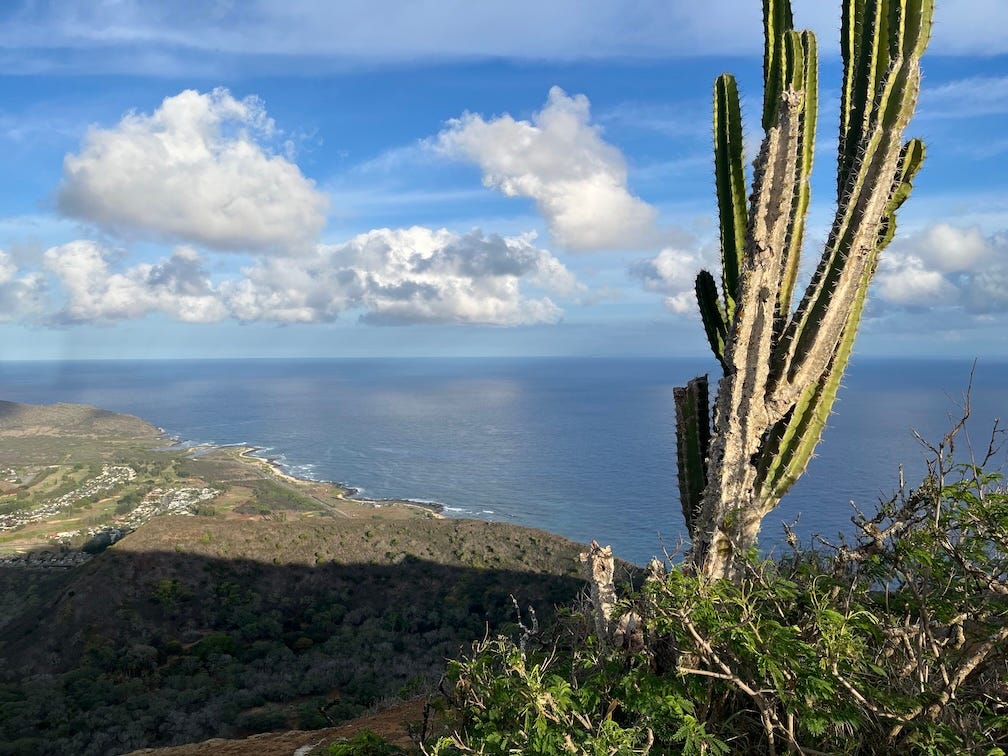
Before I left the rehab hospital, I told one of my therapists my goal was to hike Koko Head again. She let it pass without saying anything. We both knew hiking Koko Head was ambitious. AllTrails gives the Koko Crater trail a “hard” rating. It goes a thousand feet up a tramway used in WWII to bring military supplies to a lookout on the rim of an extinct tuff cone. I had reached the top once, before my stroke. It certainly seemed hard to me then. It’s basically 80 floors of steep, unevenly spaced railroad ties straight up the side of the crater. There’s no shade, and at one point the trail reaches an incline of 35%. It’s more of a challenge than it is a pleasant hike, although the view makes it worthwhile.
Anyway, here’s a picture I took from the top of the crater a few weeks ago.
Thank you for reading and for supporting Telling the Future. Related posts include “Postcard from the Hospital” and “Reflections on Surviving Strokes.” My father recently competed in and finished the Head of the Charles at 86. I hope when I’m his age I can be in anywhere close to as good a shape. If you appreciate my writing, please consider supporting me by becoming a paid subscriber—and if you enjoyed this please let others know by clicking the heart button at the bottom.

congrats on your recovery!
(I injured my own ankle about a week ago and haven't recovered yet.)
Absolutely incredible achievement. That moment where the therapist let your Koko Head goal pass without comment speaks volumes about how medical benchmarks sometimes miss what really drives recovery. I saw something similiar with my aunt after her knee surgery when she set a goal everyone thought was unrealistic. The gap between clinical expectations and human determination is where the real stories live, and this one's powerful.